A “5-gallon bucket” is one of the most standardized containers there is, but the number on the label hides a few things worth knowing before you order in bulk or pack a product into one. The real brim volume is a little over five gallons, the usable volume is a little under, and what it weighs when full ranges from trivial to more than one person should lift. Here is what a 5-gallon pail actually holds, what it weighs, and how to match its capacity to the job.
The “5 gallons” is a nominal figure
Filled to the very brim, a standard 5-gallon bucket usually holds a bit more than five gallons, often in the range of 5.1 to 5.3 gallons. The extra space is deliberate headroom for handling, lid installation and a little expansion. A useful landmark is the metal handle: the rivets where the bail attaches to the sides sit almost exactly at the five-gallon fill line, so filling to that height gives you a true five gallons with headspace above it. For liquids you should stop short of that, leaving an inch or two below the rim so the contents do not slosh out or fight the lid, which puts practical liquid capacity closer to four and a half gallons. Dry goods can go higher because they do not slosh, though a sealed food-storage setup with a Mylar liner and an oxygen absorber takes back a little of that volume. Exact brim volume also varies a little between manufacturers and wall designs, so if the precise figure matters for a fill line or a label claim, confirm the rated volume on the spec sheet rather than assuming every “5-gallon” pail is identical.
What it weighs when full
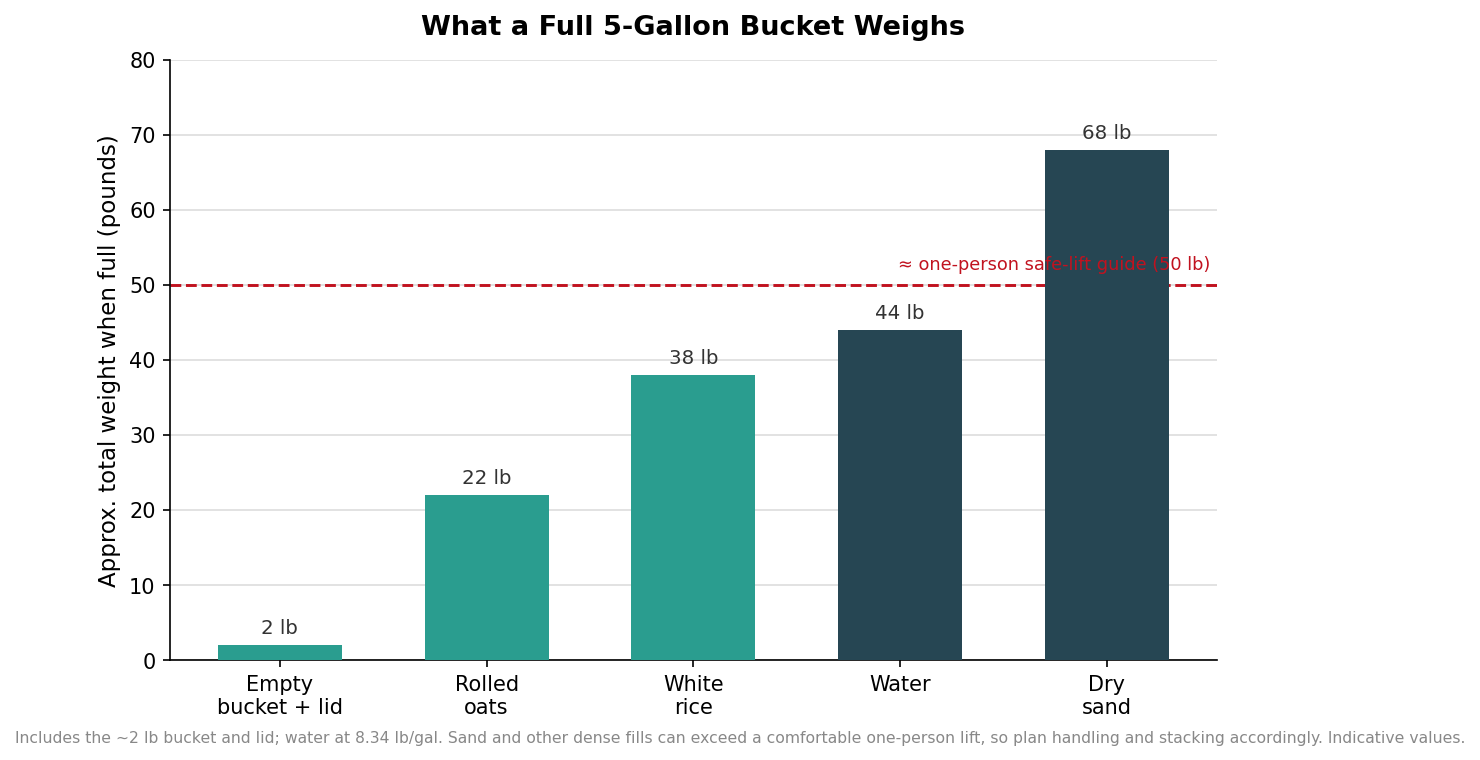
An empty bucket with its lid is light, generally between one and a half and three pounds of HDPE. Add contents and the weight climbs fast. Five gallons of water weighs about 41.7 pounds on its own, so a water-filled bucket runs 43 to 45 pounds all in. Dense materials go well past that: a bucket of dry sand can top out near 70 pounds, heavy enough that it stops being a one-hand carry and starts being a two-hand, watch-your-back lift. This matters more than it sounds, because the wire bail handle and your own back, not the bucket wall, are usually the limiting factor. If a filled pail will be lifted by hand routinely, keeping it under roughly 50 pounds is kinder to whoever is doing the lifting. A plastic grip that slides onto the bail also makes a heavy pail far more comfortable to carry, and is worth specifying when the buckets will be moved by hand often.
How much dry food actually fits
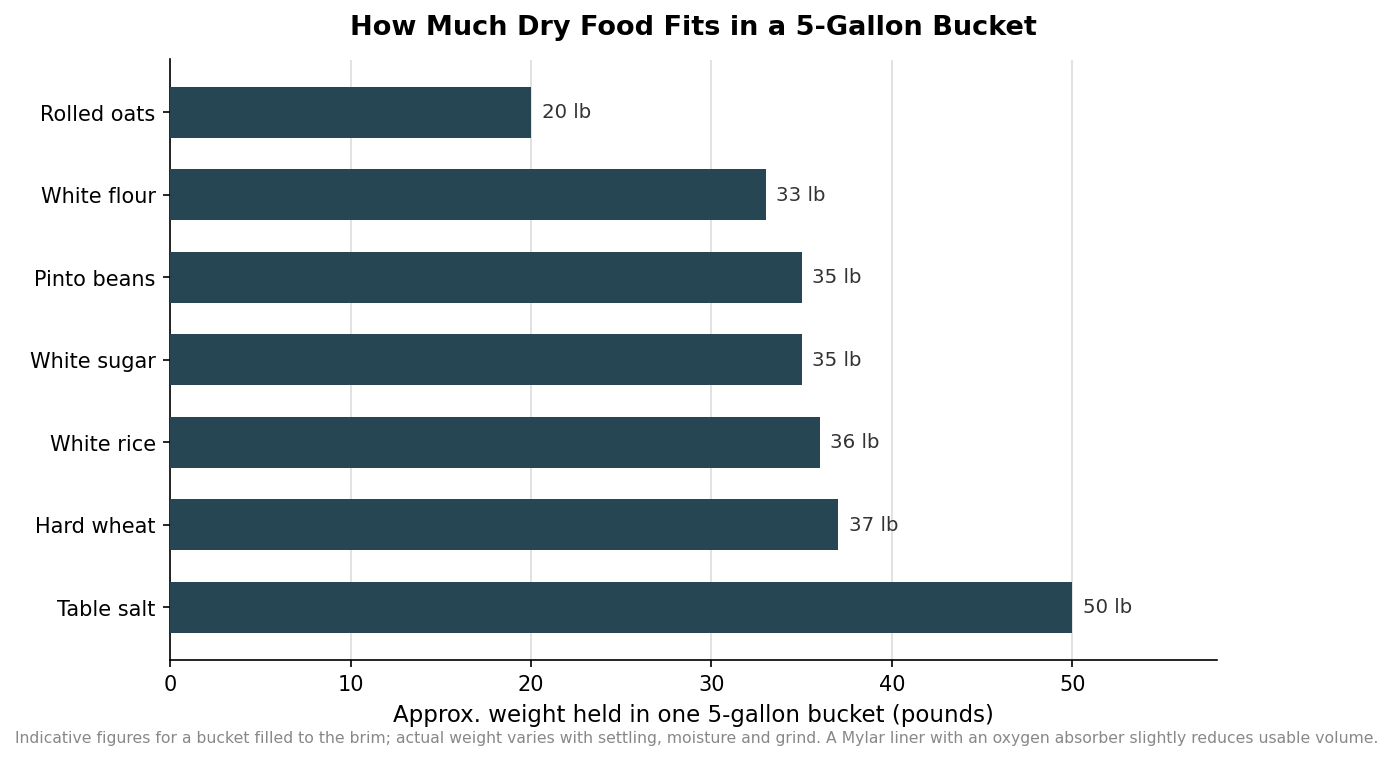
For dry goods, capacity is easiest to think about in pounds rather than gallons, because density does the talking. A brim-full bucket holds roughly 36 pounds of white rice, about 37 pounds of hard wheat, and around 35 pounds each of sugar and pinto beans. Lighter, fluffier products hold less by weight: rolled oats come in near 20 pounds because they trap so much air. Salt sits at the heavy end, close to 50 pounds, because it packs densely with almost no void space. These are working figures rather than exact ones, since settling during transport, moisture and how finely something is ground all move the number a few pounds either way. Having a rough pounds-per-bucket figure in mind is still the fastest way to estimate how many buckets a given quantity of product will need before you order lids, liners and labels to match.
Matching capacity to the job
The right size depends on how the bucket is filled and handled, not just on the volume. For liquids, coatings or anything that has to be poured, plan around that four-and-a-half-gallon working figure and the headspace it needs, and consider a spouted or gamma-seal lid if the contents will be accessed repeatedly. For packaging a dry product, think in pounds and confirm the filled weight lands where your shipping and handling can support it. For merchandise kits and promotional packs, the usable interior of a 5-gallon pail is generous, but bulky or oddly shaped items waste volume quickly, so a mock pack of one unit is the fastest way to see how many actually fit. As a rough guide for planning, the interior of a standard pail is around eleven inches across and a little over thirteen inches deep, which is roomy for soft or stackable goods but unforgiving for anything long or rigid. If your contents crowd the brim or blow past a comfortable lifting weight, that is the signal to step up to a 6- or 7-gallon pail or down to a 3.5-gallon size rather than forcing the fit.
Practical limits worth respecting
A quality HDPE pail is strong, but it has limits. Stacking filled buckets too high stresses the lower lids and can bow the walls over time, so keep stacks modest and let sturdy shelving carry the load where you can. For liquids, a gasketed lid is what actually makes the seal, and shipping certain liquids or regulated contents may require a UN-rated pail and lid rather than a standard one. And if the bucket will hold food, the container itself needs to be a food-grade resin, which is a material question separate from its size or strength. Get the volume, the filled weight and the lid right together, and a 5-gallon bucket becomes one of the most reliable, reusable packages you can put a product into.