Two custom buckets can carry the same logo and cost very different amounts, wear very differently, and reproduce that logo with wildly different fidelity. The variable that drives all three is the decoration method. Before you compare quotes on branded five-gallon pails, it pays to understand the three ways a design actually gets onto the plastic, because each one is built for a different combination of run size, artwork, and working life.
Screen printing: the volume workhorse
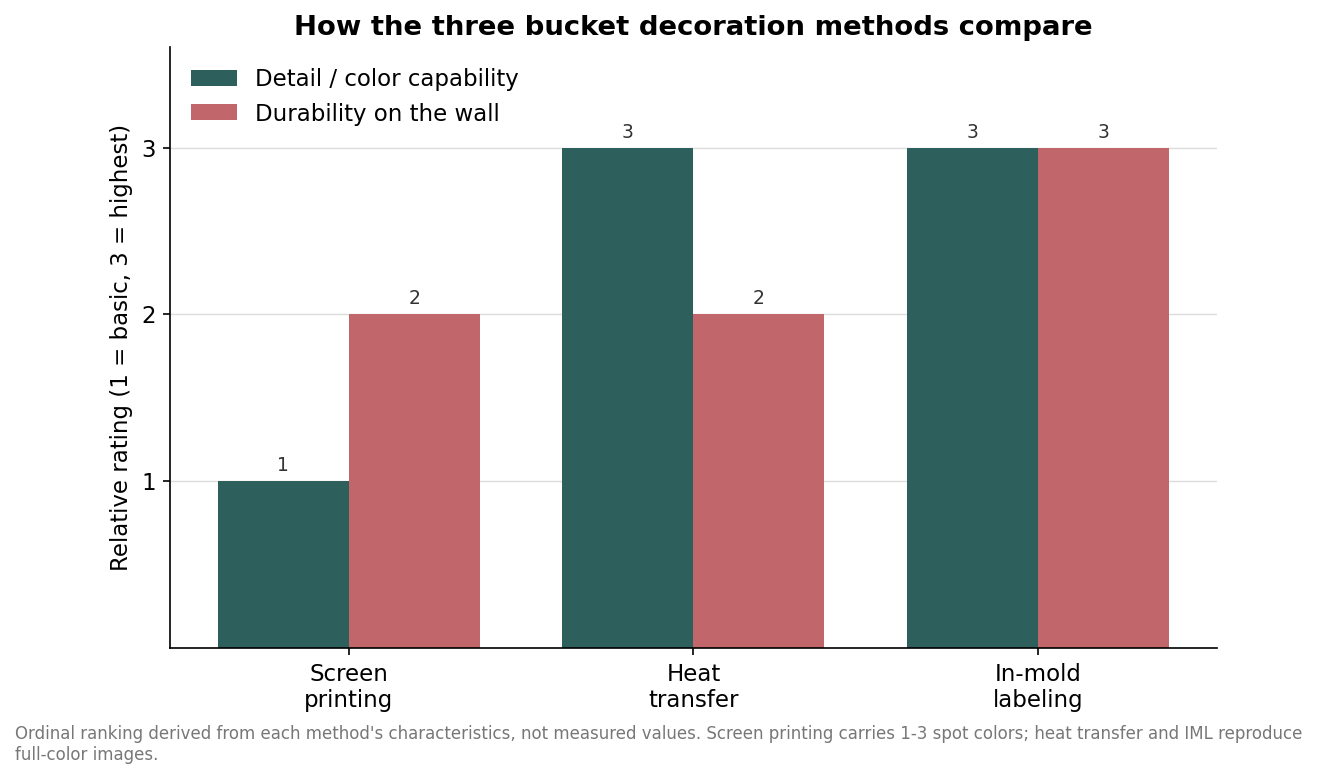
Screen printing lays ink directly onto the bucket wall through a fine mesh stencil that blocks everything except the shapes you want. It is the most common method for a reason: the setup is simple, the per-unit cost is low, and it runs cleanly at high volume. The tradeoff is color. Screen printing handles roughly one to three spot colors, so it excels at bold logos, large type, and simple line marks but struggles with gradients, photographs, or fine detail, where the result looks comparatively coarse. Order minimums reflect the setup cost of burning screens; one common food-grade pail program, for example, starts around 480 units and offers one- or two-color printing on one or two sides, with a standard palette of white, black, yellow, orange, red, purple, blue, and green before custom-matched ink adds cost. If your brand lives in a couple of solid colors and you are buying in the hundreds or thousands, this is usually the sensible default.
The cost structure is worth understanding because it explains the minimums. Each color needs its own screen, and each screen has to be made, aligned, and cleaned, so a two-color mark costs more to set up than a one-color mark and a four-color photograph is simply not what the process is for. That fixed setup is spread across the run, which is why per-unit pricing falls sharply as quantities climb and why shops set order floors in the hundreds rather than accepting a handful of pieces. Screen printing also wraps only so far around a curved wall in a single pass, so designs are placed on a panel or two rather than continuously around the bucket. For a bold, flat-color logo repeated across a large order, none of this is a real constraint, which is exactly why the method dominates promotional and bulk food-grade work.
Heat transfer: photographic detail on a curved wall
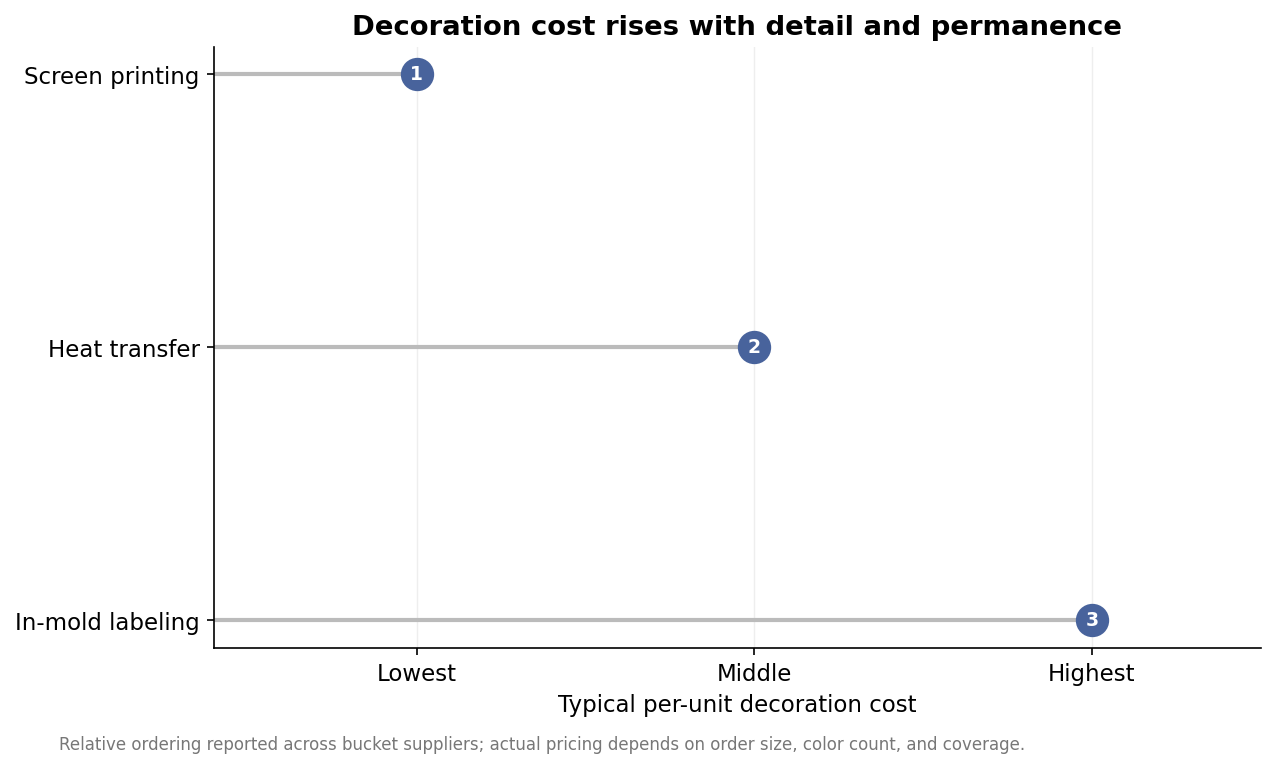
Heat transfer decoration works differently. A pre-printed film carrying your artwork is pressed onto the bucket with heat and pressure, releasing the image onto the plastic. Because the film is printed first, it can reproduce full-color, photographic images, barcodes, and fine detail that screen printing cannot touch. The bond is durable, with good water and chemical resistance, which matters for pails that live outdoors or hold aggressive contents. It sits in the middle on price, costing more than screen printing but less than in-mold labeling. Its main limitation is coverage: a transfer occupies a defined patch on the wall rather than wrapping the whole container, so you design around a panel rather than the full surface. Registration is tight enough for small text and detailed logos, and because the artwork is printed on film first, adding a second or third color does not multiply setup the way it does in screen printing. That makes heat transfer a practical bridge for buyers who need more than flat spot colors but are not ordering at the scale that justifies in-mold tooling. It is a common choice for retail-facing pails, kits, and anything where a photographic hero image or a gradient has to survive handling and moisture.
In-mold labeling: branding fused into the plastic
In-mold labeling, or IML, is the premium option and the most physically integrated. A printed film is placed inside the mold before the plastic is injected, and the two fuse together as the bucket forms. The decoration is not sitting on the surface; it is part of the wall. That yields the highest durability, resistance to fading and scuffing, and the ability to wrap the entire bucket and even the lid in high-definition, full-color graphics. The catch is cost and logistics. IML carries the highest per-unit decorating cost of the three and is tied to the injection-molding run itself, which makes it best suited to large, planned production quantities rather than a quick branded batch. When shelf presence and longevity justify the spend, nothing else looks as finished.
There is a materials advantage that is easy to overlook. IML films are commonly made from polypropylene, a close cousin of the polymer used in many pails, which means the label and container can often be recycled together rather than separated. Because the decoration is molded in, there is no printed layer to peel, scratch, or fade off in sunlight, so an IML bucket tends to look new far longer than a surface-printed one. The reason it is not the automatic choice is purely economic: the film and the molding step add real cost per unit, and committing to a molding run only makes sense when your quantity is large and your artwork is settled, since changing the design means new film rather than a quick screen swap.
Matching the method to the job
The decision usually resolves along four questions. How many colors is the artwork? One to three flat colors point to screen printing; anything photographic or gradient-heavy needs heat transfer or IML. How large is the run? A few hundred to a few thousand favors screen printing or heat transfer, while IML earns its keep at high volume. What will the bucket endure? Chemical exposure, outdoor UV, and heavy handling push you toward the more permanent transfer or in-mold options. What is the budget per unit? Screen printing is lowest, heat transfer is the middle ground, and IML sits at the top. Most branded-bucket buyers land on screen printing for straightforward logos and reserve the other two for either detailed imagery or products that need to look pristine after months of use.
The container underneath the print
Whichever method you choose, the pail itself is usually the same workhorse: high-density polyethylene, a five-gallon capacity of about 18 liters, and wall thickness in the 90-mil range on heavier food-grade models, with reinforcing ribs and a tapered body so empties nest for shipping. Regulatory graphics, such as the child-safety warning, are typically printed as part of the decoration on food-grade programs rather than added separately. Those specifications are indicative and vary by supplier, but they set the stage the decoration has to perform on. Get the method right for your colors, volume, and working environment, and the same bucket can read as a giveaway, a retail package, or a piece of durable branded equipment.
Win Free Stuff
Enter below for a chance to win plus receive 10% off your first order.
🎉 You are in!
Check your email for your 10% off code. Good luck!