A five-gallon bucket looks like the most standardized object in the warehouse, and in one sense it is: they all hold about five gallons and they all stack. But once you order in quantity, or plan to ship product in them, the differences between two buckets that look identical on a shelf start to matter. Wall thickness, resin grade, and certification stamps separate a bucket that survives a loaded pallet from one that cracks on the second reuse. Here is how to read the spec sheet.
The dimensions, and why “five gallons” is only half the story
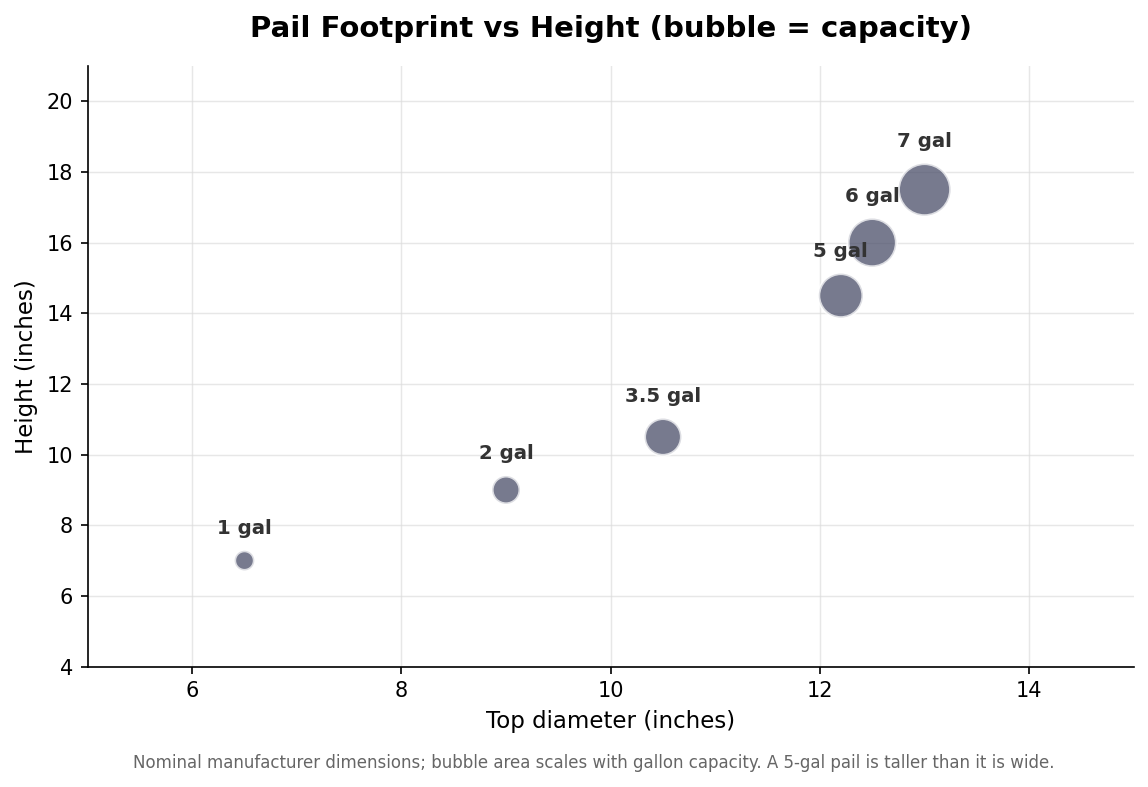
A standard 5-gallon pail runs about 14.5 inches tall with a top outer diameter near 12.2 inches and a narrower bottom around 10.3 inches, that taper is what lets empty buckets nest for shipping. Full volume is a genuine 5 gallons, which is 640 fluid ounces or about 18.9 liters, and filled with water that comes out to roughly 42 pounds. Add a snap-on lid and the height grows only a quarter inch or so, to about 14.75 inches.
The reason the label alone is not enough is that the family of pail sizes overlaps in ways that surprise people. A 3.5-gallon pail is about 10.5 inches in both height and diameter, a 6-gallon stands near 16 inches, and a 7-gallon reaches 17.5 inches at roughly 13 inches wide. Because the footprint grows more slowly than the height, the taller sizes can feel deceptively similar in width while holding noticeably more, which matters when you are fitting buckets to a shelf, a dispensing rig, or a shipping carton.
The lid decides whether the seal holds
Buckets are usually quoted separately from their lids, and the lid choice changes how the container actually performs. A plain snap-on lid presses on and stays put but is not airtight and is a struggle to remove cleanly, which is fine for tools or dry storage. A gasketed snap lid adds a rubber ring that resists moisture and leaks, the right pick for shipping liquids or keeping contents dry. For anything opened repeatedly, a screw-style gamma seal lid, an adapter ring that snaps on once and then accepts a threaded center that spins off in a second, turns a one-time bucket into a resealable, near-airtight container. Standard lids and gamma seals are sized to fit the whole 3.5-to-7-gallon pail family, so one lid style can cover several bucket sizes in your lineup.
Wall thickness is the spec that separates retail from industrial
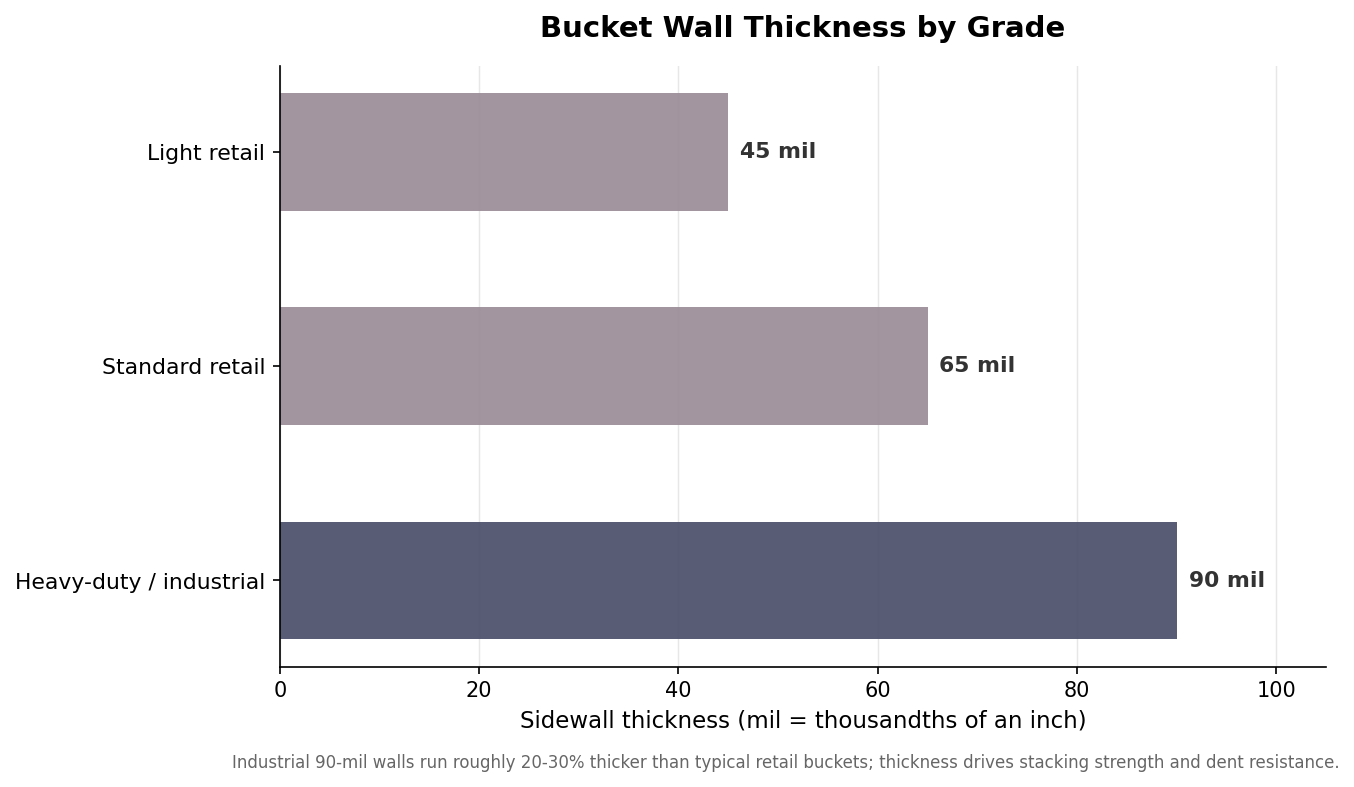
If you read one number on a pail spec sheet, make it the wall thickness, quoted in mil, or thousandths of an inch. Ordinary retail buckets are commonly around 45 to 70 mil, while an industrial-grade pail is built at 90 mil, roughly 20 to 30 percent thicker. That extra material is not cosmetic. It is what lets a filled bucket sit near the bottom of a stacked pallet without the sidewalls bowing, and it is why a heavy-duty pail shrugs off the drops and forklift bumps that dent a thin one.
The practical guidance is to match thickness to duty, not to price. For a light giveaway that holds nothing heavy and gets used once, a thinner wall is perfectly fine. For anything you will fill with product, stack, ship, or reuse repeatedly, the 90-mil grade earns its cost back in buckets that do not fail in the field. Ordering the wrong grade to save a few cents per unit is the most common and most expensive mistake buyers make with buckets.
What HDPE #2 and the certification stamps actually mean
Nearly all quality pails are molded from virgin HDPE, high-density polyethylene, carrying resin identification code 2, the small number inside the recycling triangle on the base. Virgin resin matters because recycled or reground plastic can vary in strength and is not appropriate for food contact. For food or beverage use, look specifically for compliance with the FDA food-contact regulation 21 CFR 177.1520; a bucket being HDPE is necessary but not by itself sufficient to be food-safe.
The other stamp worth understanding is the UN rating, which appears as a code like 1H2/Y27/S. That string certifies the pail for shipping certain hazardous materials and encodes the container type, the packing group it is approved for, and the maximum gross weight it was tested to, often around 60 pounds for a 5-gallon pail. If you are shipping regulated liquids, the UN mark is not optional; if you are just packaging dry goods or using buckets for storage, it is a durability signal you can treat as a bonus rather than a requirement.
Choosing the size and grade for the job
Put the specs together and the selection becomes straightforward. Start with volume and weight: a 5-gallon of a dense product can exceed 40 pounds, which is near the comfortable lifting limit for one person, so for heavier contents a 3.5-gallon may serve workers better even though it holds less. Then set the wall grade by how the bucket will live, thin-wall for single-use and light contents, 90-mil for anything stacked, shipped, or reused. Finally, confirm the resin and certification match the contents: HDPE #2 with FDA compliance for anything edible, and a UN rating if the contents are regulated for transport.
Every figure here is a nominal manufacturer specification, and real buckets vary a little between molds and suppliers, so treat the dimensions and weights as close guides rather than exact guarantees. But specifying capacity, wall thickness, resin, and any required certification up front gives a supplier everything needed to quote the right bucket the first time, and spares you the far larger cost of discovering the difference after a pallet has already shipped.
Win Free Stuff
Enter below for a chance to win plus receive 10% off your first order.
🎉 You are in!
Check your email for your 10% off code. Good luck!